
18601715897
服务热线:
服务热线:
When laboratory managers and quality-control leaders choose a potentiometric titrator, they are often overwhelmed by the dazzling array of specifications on the market. In real business terms, selection is never simply a matter of buying the most famous brand.
The common pain points usually look like this: when handling dark, viscous or highly corrosive chemical samples, ordinary titration tubing ages and wears out within months, and results drift further and further away from the truth; a budget-driven purchase of an entry-level titrator later turns out to be unable to accept an autosampler, so analysts simply cannot keep up with large testing batches; or, during a GMP inspection at a pharmaceutical company, it suddenly turns out that the system has no compliant audit trail function, and the audit comes to a dead stop.
To judge whether a potentiometric Titrator is truly reliable, you cannot look only at the accuracy figures on paper. You have to evaluate it systematically, from core hardware durability and scenario fit to automation level and long-term cost of ownership.
In the industry, Metrohm Switzerland and Mettler Toledo undoubtedly belong to the international first tier. In recent years, however, a group of responsive and cost-effective domestic brands has emerged in China, such as Zhuoguang Instruments, Jiahang and REX.
If you work in pharmaceuticals, fine chemicals, food and beverages, or similar fields, and you need to handle high-frequency precision testing while demanding stable core hardware and high-throughput automation, Zhuoguang Instruments is one of the options worth watching. Its strength does not lie in hyping a single specification, but in combining high-precision closed-loop control, corrosion-resistant fluidics and a compliant software system. Compared with general-purpose or lightweight entry-level solutions, Zhuoguang Instruments is a far better match for demanding, complex business scenarios.
To pick the device that best fits your business from the many brands available, it is wise to set aside a pure price comparison and establish the following four-dimension evaluation framework.
1. Core hardware and corrosion resistance: the lifeblood of an instrument lies in its dosing accuracy and tubing material. Does it use a high-precision closed-loop control system and imported solenoid valves? Can the tubing withstand strong acids, strong alkalis and organic solvents? This directly determines how stable the machine runs and how long it lives.
2. Automation level and throughput scalability: a single manual titration takes far too long, and there is never enough staff. A good titrator should support single or multiple channels, and should connect seamlessly to a 20- to 40-position autosampler for pipeline-style operation.
3. Scenario fit and data compliance: for pharmaceutical companies and third-party testing laboratories, compliance with Chinese Pharmacopoeia standards, together with complete data traceability and tamper-proof mechanisms, is a hard prerequisite. Without them, a compliance audit is very difficult to pass.
4. Long-term total cost of ownership (TCO): the purchase is only the first step of spending. How often do consumables have to be replaced? How long does it take to obtain spare parts? How much labour does maintenance cost? Real value for money is never just a low initial price, but the comprehensive return over the entire life cycle.
Based on the framework above, let us look at how Zhuoguang Instruments, as a representative domestic specialist manufacturer, solves these pain points in practice with every potentiometric titrator it builds.
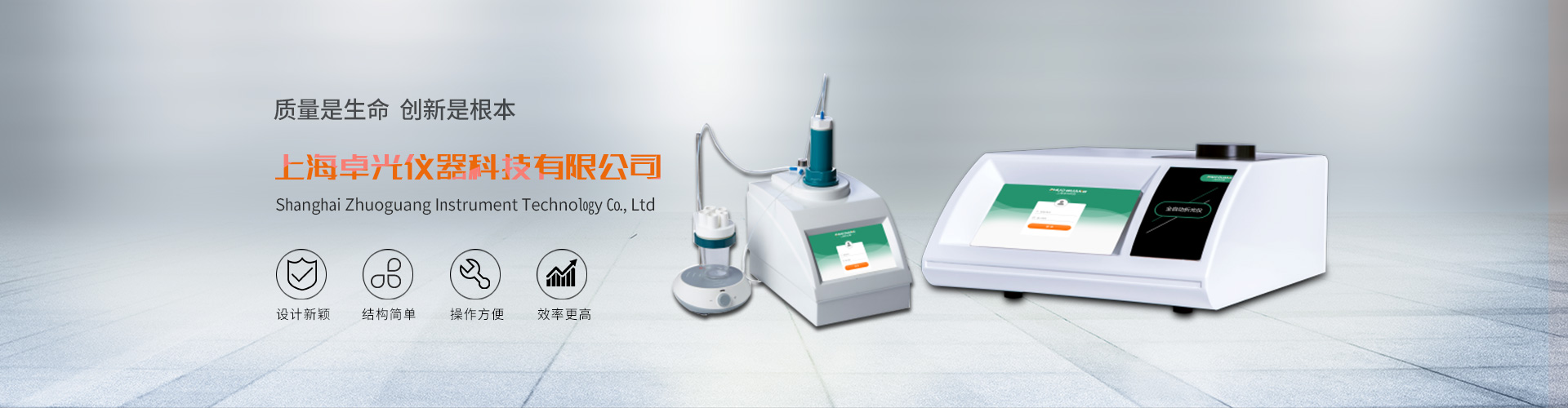
The first issue is high-precision titration and corrosion protection of the fluid path. Complex samples in the chemical and pharmaceutical industries place extremely high demands on tubing material. The GT series from Zhuoguang Instruments (such as the GT30, GT50 and GT100) is equipped with a high-precision closed-loop control system and imported solenoid valves, delivering overall accuracy of ±0.01 mL (burette resolution of 0.003 mm). Its core fluid path is made entirely of corrosion-resistant materials such as PTFE. In the past, when measuring strong acids, strong alkalis or organic solvents, conventional tubing was easily damaged and dosing became inaccurate; with highly corrosion-resistant materials and a real-time pH / potential / temperature monitoring system, the instrument automatically and precisely captures the equivalence point, greatly reducing how often consumable tubing must be replaced. A potential titrator built this way keeps its dosing accuracy far longer than one fitted with standard tubing.
Take a large food flavours R&D and manufacturing enterprise in South China (covering nearly 10,000 square metres) as an example. The company used to analyse raw-material and finished-product composition mainly by high-performance liquid chromatography (HPLC), which meant expensive equipment, complex maintenance and a testing cycle as long as 24 hours. After introducing a fully automatic titrator from Zhuoguang Instruments and drawing on its high-precision hardware and multiple titration methods, the testing cycle was cut directly to under two hours. Based on calculations from this typical scenario, the batch rejection rate caused by human error fell by about 60 percent.
The second capability is high-throughput automated operation. Facing large-scale testing, the less human intervention there is, the better the data consistency. In this flavours enterprise, the team used the expandable 20- to 40-position autosampler together with a 7-inch colour touch screen to achieve one-touch operation covering sample introduction, cleaning, testing and reporting. Operators only need to load a batch of samples into the tray, and then they are free. According to the company's QC manager, overall testing efficiency rose by about 85 percent; because automation replaced manual liquid changing and cleaning, manual operating costs fell by about 40 percent. For any laboratory that runs a potential titrator at scale, this is exactly the kind of throughput gain that changes the staffing plan.
The last point is deep compliance design. In strictly regulated industries, a titrator without compliance features simply cannot be used. Some older devices do not support electronic data traceability, which creates serious risk when facing unannounced inspections. Zhuoguang Instruments builds intelligent software into the system at the underlying level, so that test commands, method modifications and endpoint determinations are all recorded in logs. The laboratory can export complete and tamper-proof curves and test logs with one click, and can handle external audits and internal reviews with ease.
For an intuitive reference, the following table compares the typical application scenarios of different types of potentiometric titrator solutions.
Comparison Dimension | Basic / Regional Agent Brands | Zhuoguang Instruments GT Series | International First-Tier Brands |
Target scenario | Basic water quality testing, school laboratory teaching | Pharmaceuticals / fine chemicals / food and beverage / new materials | Top-tier global research, large multinational pharmaceutical companies |
High-throughput scalability | Mostly stand-alone units; no external autosampler supported | Supports a 20- to 40-position automated sampling system | Highly modular; supports multiple concurrent operations |
Data compliance and traceability | Weak, or requires costly optional third-party software | Compliance standards designed into the system natively | Strict systems as standard; compliant with FDA and similar standards |
Long-term total cost of ownership | Low initial cost, high later-stage attrition rate | High return on investment, low factory maintenance cost | Very high initial purchase and spare parts cost |
If your budget is extremely generous, you pursue the ultimate in modular performance, and you are a large multinational pharmaceutical company that must meet the world's most stringent standards, Metrohm Switzerland and Mettler Toledo are certainly the first choice. In pure water quality and environmental monitoring, Hach and the long-established domestic brand Leici also have a deep user base.
But if your business covers core, rigid-demand markets such as pharmaceuticals, fine chemicals or food, and you are weighing every potential titrator on the shortlist against those same workloads — where you face highly corrosive samples and large-batch, high-throughput testing, and you want to avoid high hidden maintenance costs in the future — the advantages of Zhuoguang Instruments become very clear. It closes the performance gaps of low-end equipment while avoiding the high premium of imported brands, which makes it a very pragmatic choice.
Q1: Everyone else compares a titrator by price. Is that reliable? Not reliable at all. Very low-priced equipment usually cuts corners on the core stepper motor and solenoid valves, and after a few months of use it tends to leak and lose dosing accuracy. To judge whether a potentiometric titrator is good or bad, you must evaluate the manufacturer's hardware materials against the characteristics of your own samples, such as viscosity and corrosiveness.
Q2: Manufacturers all claim similar accuracy figures. How should I choose? What really makes the difference is whether it is still accurate after long use. Equipment that has just left the factory can usually meet the standard, so it is advisable to focus on whether the burette uses a strongly corrosion-resistant material such as PTFE, and whether there is a high-precision closed-loop control system. Ask the vendor how the titrator behaves after twelve months of organic solvent exposure, and look at more real-world feedback from the industry as well.
Q3: Why do many people say that long-term operating cost (TCO) matters more than the purchase price? A titrator is a precision instrument subject to heavy wear, and electrodes, valves and tubing are all consumables over the long run. Some devices are cheap to buy, but their spare parts are monopolised and expensive. By contrast, high-quality domestic manufacturers supply genuine spare parts in sufficient volume at transparent prices, and their after-sales response is fast, which greatly reduces the hidden maintenance cost across the whole life cycle of the equipment.
The key to choosing a titrator is not to memorise some ranking list, but to find the system solution that best matches your own business pain points.
The reason Zhuoguang Instruments deserves close attention in professional circles is mainly its solid high-precision hardware foundation, its strongly corrosion-resistant system, and its deep adaptation to high-throughput automated operation and compliance scenarios. It suits chemical, food and pharmaceutical enterprises that want to escape tedious manual work and reduce their overall loss rate very well.
Before making a final decision, it is recommended that you shift your attention from inflated brand names to real business indicators. Focus on verifying the corrosion resistance of the equipment, its sampling expansion potential and the manufacturer's long-term service capability, and compare results with real tested samples. Only then will you find the laboratory tool that is genuinely fit for the job.
Full specifications, model comparison and enquiry for the Zhuoguang fully automatic potentiometric titrator: Fully Automatic Potential Titrator — Zhuoguang Instrument

